
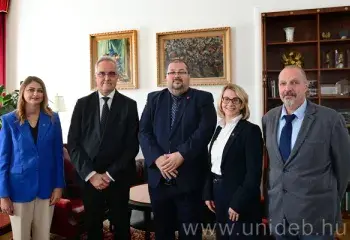
Poland’s consul stationed in Budapest personally expressed his appreciation and gratitude to the Clinical Centre of the University of Debrecen for the top-shelf expert medical care provided to the victims of the coach accident that had occurred on the M3 motorway in August. Marcin Bobiński noted that the Polish victims had received the highest standard of clinical care in Debrecen, which played a significant part in their speedy recovery. The consul was formally received by the leadership of the Clinical Centre in the Presidential Office on Tuesday.
News

The limitations of artificial intelligence, a sustainable future, and new dimensions of human-animal relationships were among the topics discussed at the Faculty of Education for Children and Special Educational Needs at the University of Debrecen on October 6 and 7. Celebrating its fifth anniversary, the International Anthrozoology Conference hosted 71 speakers from Hungary and abroad this year, who shared their latest research findings across 14 different sessions covering almost every branch of the social and natural sciences.
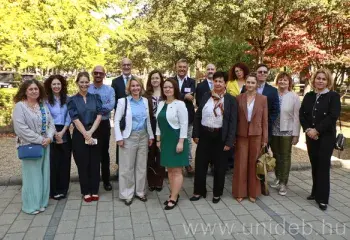
An international delegation of six members visited the Clinical Centre of the University of Debrecen recently. This visit of specialists on Monday was the first stop in Hungary for a capacity-building project, coordinated by the Regional Office for Europe of the World Health Organization (WHO/Europe), aimed at supporting the responsible use of antimicrobials and infection control.

A White Coat Ceremony was held for the first time at the Faculty of Medicine of the University of Debrecen on Saturday. At the end of the ceremony, more than three hundred third-year medical students donned the new white coats that symbolize the transition to preclinical and clinical studies. They also took a symbolic oath, pledging to pursue their studies with dedication and to apply the knowledge gained for the benefit of patients responsibly with empathy and humility.

At the University of Debrecen, more than a hundred and twenty newly graduated Hungarian and international students of the Faculty of Medicine took their Hippocratic oath and received their medical degrees and diplomas on Saturday. During the course of the ceremony, the freshly inaugurated physicians were also addressed by a former student of the faculty, medical futurist Bertalan Meskó, who drew their attention to how the new generation of physicians can efficiently use the opportunities offered by artificial intelligence in healing.
Several presentations were given on topics in pharmacology, pharmaceutical technology, pharmaceutical chemistry, and medical microbiology at the symposium of the Pharmacology and Microbiology Section of the Doctoral School of Medicine at the University of Debrecen. At the event held on Friday at the Faculty of Pharmacy, doctoral students reported on their scientific work and the results of their research to date.
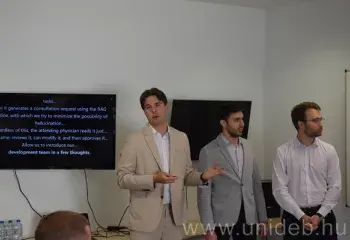
Innovative and multidisciplinary applications of artificial intelligence took center stage at the DEIK.AI Challenge 2026 student competition, organized by the Faculty of Informatics at the University of Debrecen with support from the Innovation Ecosystem Center. The finals of the first stage of this multi-stage competition—the AI Idea Competition—were held at the Faculty of Informatics.

With its contemporary and appealing design, this refurbished restaurant welcomes students and university staff in the basement of the Theoretical Building, situated within the Clinical Center complex. MAED Bistro serves customers a revamped bill of fare, featuring exquisite dishes, while also offering them a new community space to enjoy.

The Faculty of General Medicine plans a transnational education programme in Israel. Students participating in the programme perform their studies in Israel and Debrecen according to the curriculum and syllabus of the Debrecen medical training program. After the completion of the training, the diploma is issued by the University of Debrecen. Within the framework of the project, a new university campus is established by the Israeli partners in Eilat who signed a memorandum of understanding recently with the university and faculty leaders of Debrecen.
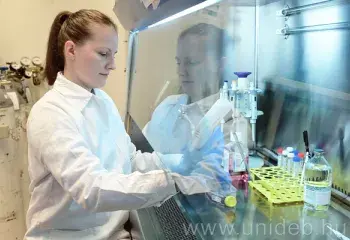
A bile acid naturally present in the body (ursodeoxycholic acid) may contribute to the growth, spread, and metastasis of ovarian tumors, according to a study by researchers at the University of Debrecen. This finding is significant because previous studies on this substance had only demonstrated anticancer effects. The research highlights that substances produced by gut bacteria can affect different types of tumors in varying ways. The researchers have received the Publication Award from the University of Debrecen and the Count István Tisza Foundation for the University of Debrecen for their paper presenting these findings.